
Finding Babylon Resident Records
Babylon has no single public roll that identifies every person at every address. The Town Assessor, Suffolk County Clerk, County GIS, elections offices, courts, and local-history collections each hold a narrower kind of evidence. Start with an address when you need a parcel trail. Start with a full name and a second, non-sensitive anchor when you need to distinguish people with the same name. A tax mailing address, a deed party, and a voter lookup response are different records, so none should be presented as a complete current-resident list.
For a historical household, a dated telephone directory or newspaper notice can supply an address that leads to maps and recorded land documents. For a current record, note the access date, the office, and whether the result came from an index, image, map layer, or record card. That small log matters when sources disagree.
- Check the Town Assessor or Suffolk GIS for the address, parcel lead, and the Town’s tax-map identifier.
- Use that identifier in the Suffolk County Clerk search, then narrow by document date and party role.
- Use the state voter service only for a specific registered-voter query, not as a street roster.
- For a past household, compare a directory or newspaper date with map, deed, and census-era material.
- Send a narrow FOIL request for an existing Town record that is not published online.
Note: A no-result can reflect a spelling variant, a different jurisdiction, a restricted record, older material, or a portal limit.
Babylon Resident Record Offices
The Town and County divide the records trail. The Assessor administers property cards and rolls, while the County Clerk indexes recorded instruments. Suffolk’s Real Property Tax Service Agency maintains parcel-identification functions, and the state voter service handles a particular voter lookup. The Town Clerk is the municipal records keeper and the FOIL route for existing Town records that are not posted. Each office answers a different question about Babylon residents.
Town of Babylon Assessor
Property rolls, assessment records, parcel cards, and exemptions.
The Assessor’s property-search service is a useful starting point for a Babylon residents directory search because it ties a situs address to assessment administration. It does not settle title or prove who currently occupies a home.
The official assessor search landing page shows the public property-search route available for Babylon research.
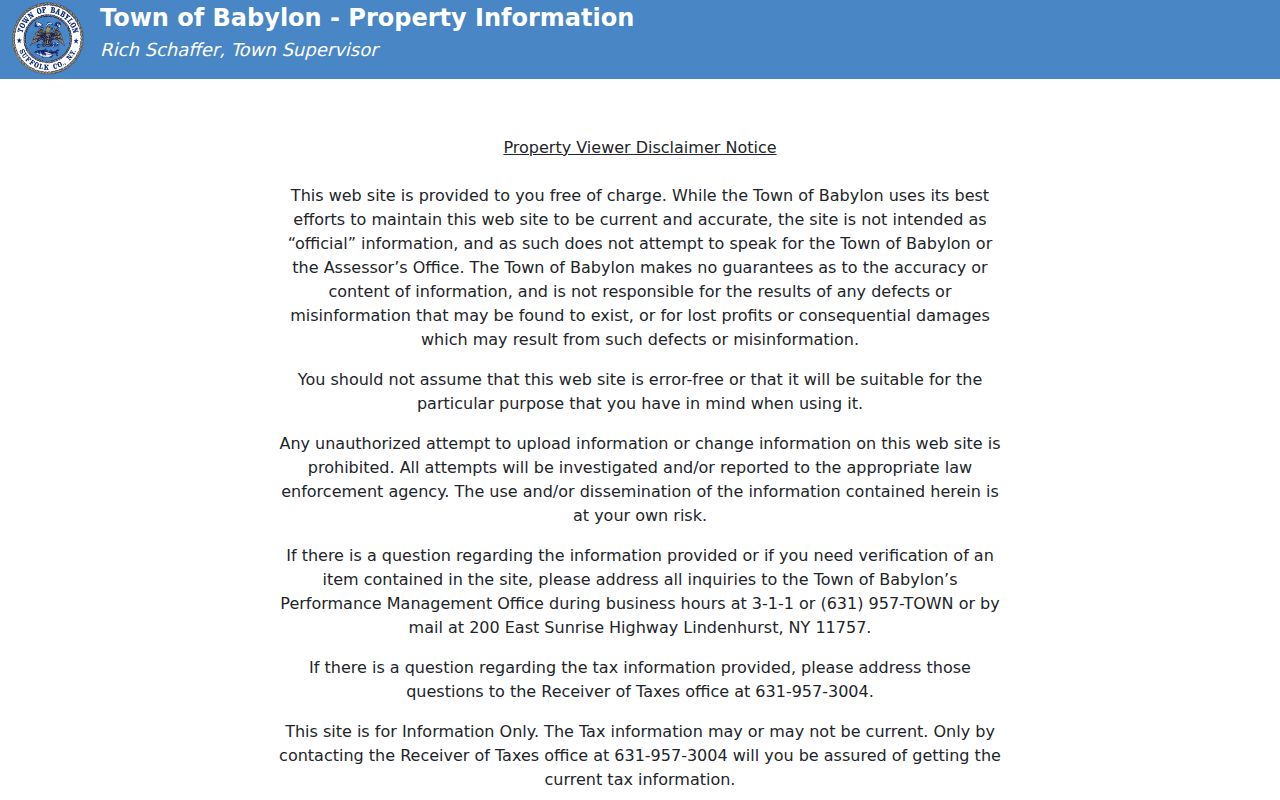
Use a property result as a parcel lead, then reconcile it with the recorded deed index and the applicable roll year.
Babylon Address Record Trail
An address-first trail is especially useful in Babylon because a parcel can carry several labels. Preserve the address as supplied, then record the postal city and ZIP separately from Town, village, hamlet, and service-district names. The Suffolk GIS parcel layers can locate roads, adjacent parcels, districts, and reference features, but the County states that GIS maps are for reference. A tax map, deed, or survey controls where a legal boundary matters.
The County Clerk’s address form accepts house number, street, and ZIP before it returns candidate tax-map rows. Those rows can include group and district, section, block, and lot context. The Clerk advises that a condominium search needs the exact tax-map number, so an address no-result is not proof that no record exists.
| Field | Why keep it |
|---|---|
| Situs address | The physical parcel location used for assessment and map work. |
| Mailing address | Tax correspondence field, which may be different from the situs. |
| SCTM or DSBL | Suffolk district, section, block, and lot key for stable parcel research. |
| Recorded date | Date an instrument reached the Clerk, not necessarily the event date. |
For the complete address workflow, the Babylon street directory keeps the focus on current street and parcel research.
Babylon Parcel Search Fields
A parcel is a legally mapped piece of land, not a household. The Assessor documents owner, property and mailing addresses, SCTM or DSBL, assessment data, exemptions, property class, and related permit or survey references where available. The exact live Assessor controls were not fully verifiable in the research, so it is better to confirm the portal’s current search options than to assume an owner-name filter works a particular way.
The Assessor’s official office page provides the Town’s final and tentative roll links and explains its property-record role.
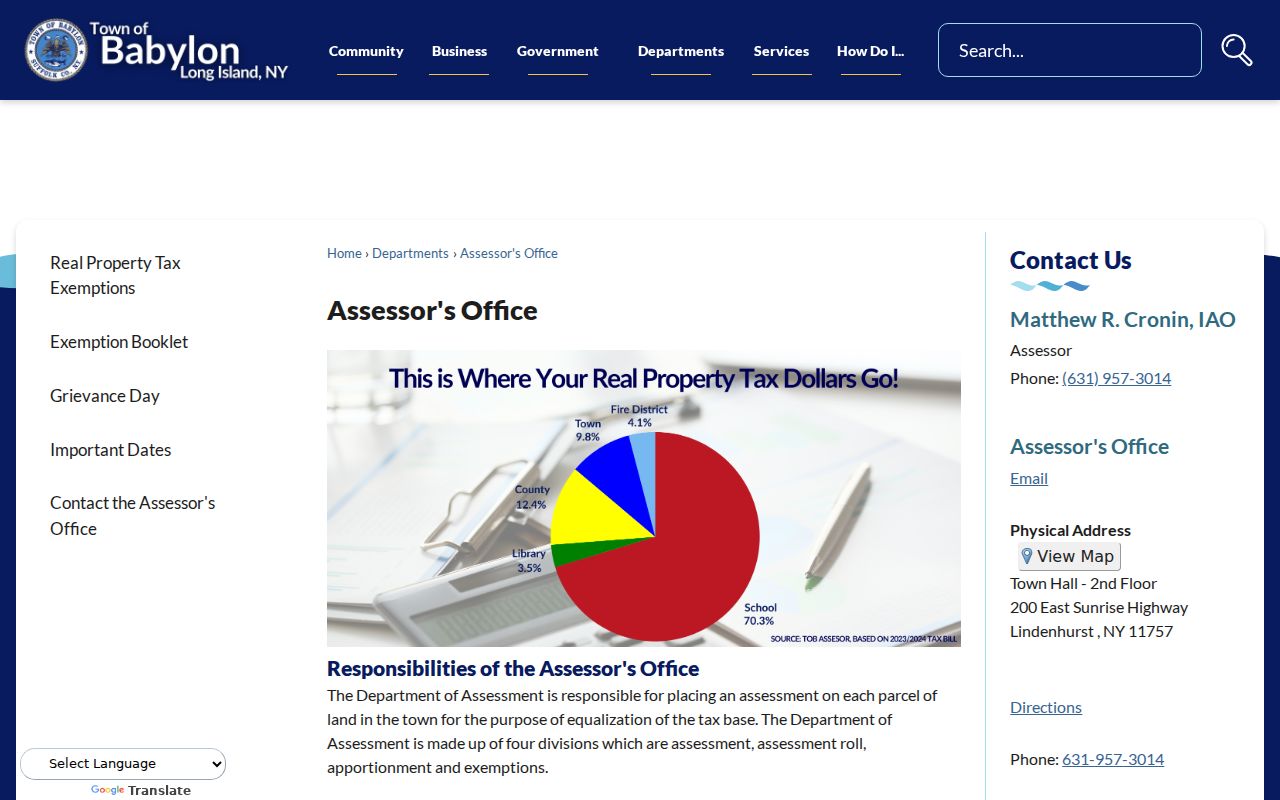
The roll year should stay with every note because an assessment year is neither a deed date nor a current market-value claim.
- Parcel
- A mapped unit of land identified in Suffolk by district, section, block, and lot.
- Index
- A finding tool that points to records; it is not the same as the document image.
- Grantor and grantee
- The party conveying an interest and the party receiving it in a recorded instrument.
- Criss-cross directory
- An address-arranged directory; no verified Babylon run was located, so ask a repository before relying on one.
Current Babylon Resident Sources
Current Babylon resident sources describe different relationships to a place. Assessment information is about tax administration. A deed index records a transaction. The voter tool is a particular-person service, and voter-file access has statutory restrictions. Court, license, and entity records can confirm an administrative connection, but a caption, service address, or license field is not proof of where someone lives.
| Babylon source | What it can show | Custodian | Access |
|---|---|---|---|
| Assessment roll or card | Owner field, parcel, situs and mailing fields | Town Assessor | Rolls, portal, or focused request |
| Recorded-land index | Grantor, grantee, instrument, liber and page | Suffolk County Clerk | Public index; copies can cost more |
| Voter lookup | Specific voter registration or polling-place response | NYS and Suffolk BOE | Name, county, date-of-birth, and address context |
| Permit or board file | Public application or property process information | Town Building and Planning | OpenGov or FOIL by record and date |
If the goal is to sort out one person rather than an address, the Babylon resident lookup uses a name-to-record verification sequence.
Reading Suffolk Clerk Results
The County Clerk’s portal is an index first. Deed results can show the grantor and grantee, liber, page, document type, date received, notations, and controls for a certified copy or document view. Mortgage results use mortgagee and mortgagor roles. The online land-record context reaches 1987 to the present; older indexes and books may require the Clerk, FamilySearch, or a local repository.
Broad searches have a hard limit. The Clerk says only the first 2,000 records display, so a capped search must be narrowed with a date range, exact or starts-with matching, municipality, or tax-map key. The portal’s current warning also notes that some judgment and lis pendens functions may be unavailable. A failed query does not prove a negative.
When the online index is not enough, the County Clerk’s Public Access route accepts a focused copy request at 310 Center Drive, Riverhead, NY 11901. Include the party names, tax-map or liber and page reference, document type, date range, and whether a plain or certified copy is needed. The public pages describe different copy routes and costs, so verify the current fee before mailing a check or money order. An older volume may instead need the counter, FamilySearch, or a library and archive search.
- Document type: identifies the recorded instrument category.
- Liber and page: book-and-page placement used to request or locate an older instrument.
- Date received: the Clerk’s recording intake date.
- View or copy option: access indicator, not a promise that every image is free.
Note: Keep the original search terms and date with any Clerk result because a name-only search may combine different people.
Babylon Voter Record Access
The state voter service is designed for a specific registered-voter lookup. Its visible fields include county, last name, first name, date of birth, ZIP or address context, and a search action. It is not a browseable Babylon street directory. Election Law §3-220 makes registration records available for inspection under stated limits, while identification numbers, signatures, protected data, and confidential-voter information are not a free public directory.
| Voter lookup field | Research use |
|---|---|
| County | Select Suffolk before searching. |
| Name | Match the registered name, not a guessed nickname. |
| Date of birth | Required matching field shown by the state service. |
| ZIP or address | Refines a specific-person query, not a block browse. |
A voter-file request goes through the state’s FOIL process and requires an elections-purpose statement under Election Law §3-103(5). Suffolk can provide a voter-card copy by written request with the full name, address, date of birth, signature, and the listed fee. Protected people must never be reverse-engineered from another source.
Babylon Places Need Context
“Babylon” can mean a Town, a village, a hamlet, a postal city, or a service area. That distinction changes which office has a record. The Town’s own examples show that an address can use a West Babylon or Wheatley Heights postal label while being tied to a Wyandanch school or library, a different fire district, and Town of Babylon government. ZIP 11798 is the clearest local example: Wyandanch and Wheatley Heights share its post-office story, while their other service labels can differ.
Use USPS for an address-level ZIP check, then use Town and GIS layers for jurisdiction and service context. A ZIP is a delivery route, not a reliable statement of village, school district, fire district, or a person’s residence. Babylon’s documented postal labels need to stay separate from their town and service-boundary context.
Historical Babylon Resident Directories
Historical work uses dated evidence, not a present-tense list. The Library of Congress telephone-directory guide identifies Babylon among New York Telephone and NY & NJ Telephone Co. exchanges, with 1892 and 1895 through 1898 holdings. Exact local printed-directory runs and an actual Babylon entry were not rendered during research, so a catalog or reading-room request is needed before claiming an address-arranged or reverse directory exists.
Babylon Library, the Town Historian, NYS Historic Newspapers, FamilySearch land records, maps, and newspapers provide companion trails. A single entry may contain a name, address, telephone exchange, or historical occupation. It establishes a dated lead, not continuous residence, ownership, or a family relationship.
The Town Clerk describes municipal records from 1872 to the present, including Town Board and other-board minutes. For an older municipal file that is neither in a library collection nor online, identify the department, record type, and date before using the Town’s FOIL form. Town staff are not required to create a new historical directory or answer an open-ended research question.
Babylon Newspaper and Map Shelf
The Town’s March 2026 local-history guide brings together newspapers, atlases, Sanborn maps, aerial imagery, and repositories. Its newspaper runs include the South Side Signal from 1869 to 1920, Babylon Leader from 1910 to 1958, Babylon Eagle from 1928 to 1963, and Babylon Beacon from 1967 to 2024. The nearest community title may be more useful than the legal Town name, especially for Amityville, Copiague, Lindenhurst, Wyandanch, or Deer Park.
Sanborn maps can establish whether a structure appeared at a stated month and year and describe footprint, material, or fire features. They generally do not name an owner or occupant. Combine a map with a dated directory or newspaper, then reconcile it against a deed or tax-map record.
Babylon’s record history helps explain the spread of sources. The railroad reached Deer Park in 1842 and Babylon in 1867, while the Town became separate in 1872. The postwar population increase brought newer suburban parcels and service districts into the record trail. Those dates are useful for choosing a newspaper title, map series, or municipal source, but they do not turn a historic place label into a modern address claim.
The Library of Congress telephone-directory guide documents the exchange holdings that make this kind of Babylon residents directory research possible. The catalog guide is a route to a collection, not evidence that every Babylon year or entry is digitized and ready to search.
Babylon Records Changes in 2026
Modern Babylon records are moving between systems. Building, Planning, and ZBA applications and supporting materials moved to the Town’s OpenGov Online Permit Center on February 2, 2026, after a short transition. Older files may be in a legacy system, paper file, or migrated account, so a request should identify the permit type and date rather than assume the newest portal holds everything.
The Town’s OpenGov transition notice identifies the change for applications and existing accounts.

The shift is a records-location issue, not a change in what a permit or board file can prove about a person or parcel.
Suffolk District Court also announced e-filing beginning August 3, 2026. Court researchers should check WebCivil Local and NYSCEF when the case type and date fit, while remembering that sealed and restricted matters will not appear as ordinary public results.
Babylon Entity Record Limits
State entity and license records can be useful when a historical business, organization, or public filing supplies a second identity anchor. The Department of State entity database can return entity name, organization date, jurisdiction, county, service address, registered agent, and status. A service address or registered agent is an administrative contact, not a home address and not evidence of current residence.
New York’s official entity search shows the public search route for administrative records.
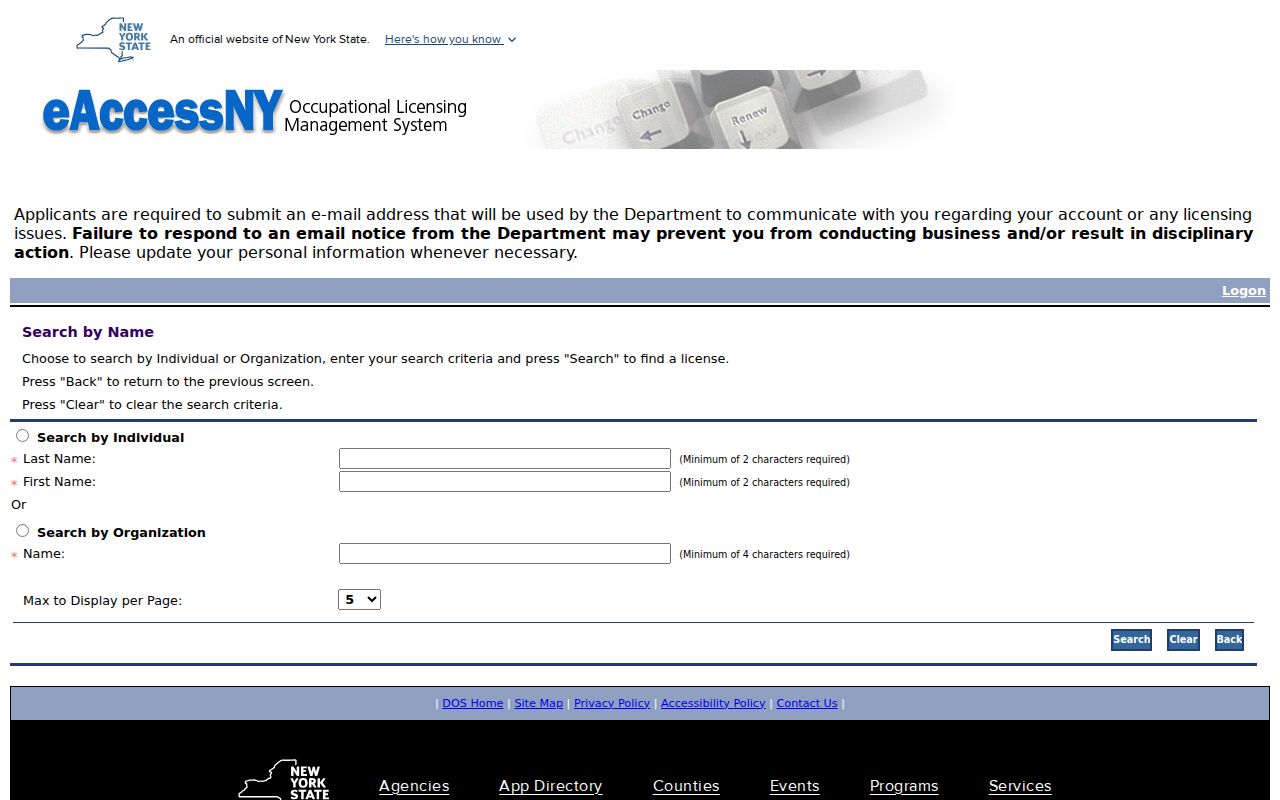
Use the record’s own date and status, then keep an entity, officer, agent, and individual person separate in research notes.
Protecting Babylon Record Privacy
New York Freedom of Information Law, Public Officers Law Article 6, §§84–90, gives a route to reasonably described existing agency records. The Town’s form asks for a precise record description and ordinarily acknowledges a request within five business days, with an approximate date or additional notice if it needs more time. It does not require an office to create a new list or answer a broad question.
Access is not permission to combine and republish every field. The Address Confidentiality Program, confidential-voter procedures, sealed court matters, protected addresses, minor records, and motor-vehicle rules can limit what is visible. Use official records for legitimate personal, civic, and historical research, minimize sensitive details, and never use a name or address trail to stalk, harass, or harm another person.
The NYS DCJS registry search form illustrates another restricted public system with its own scope, search mode, and warning.
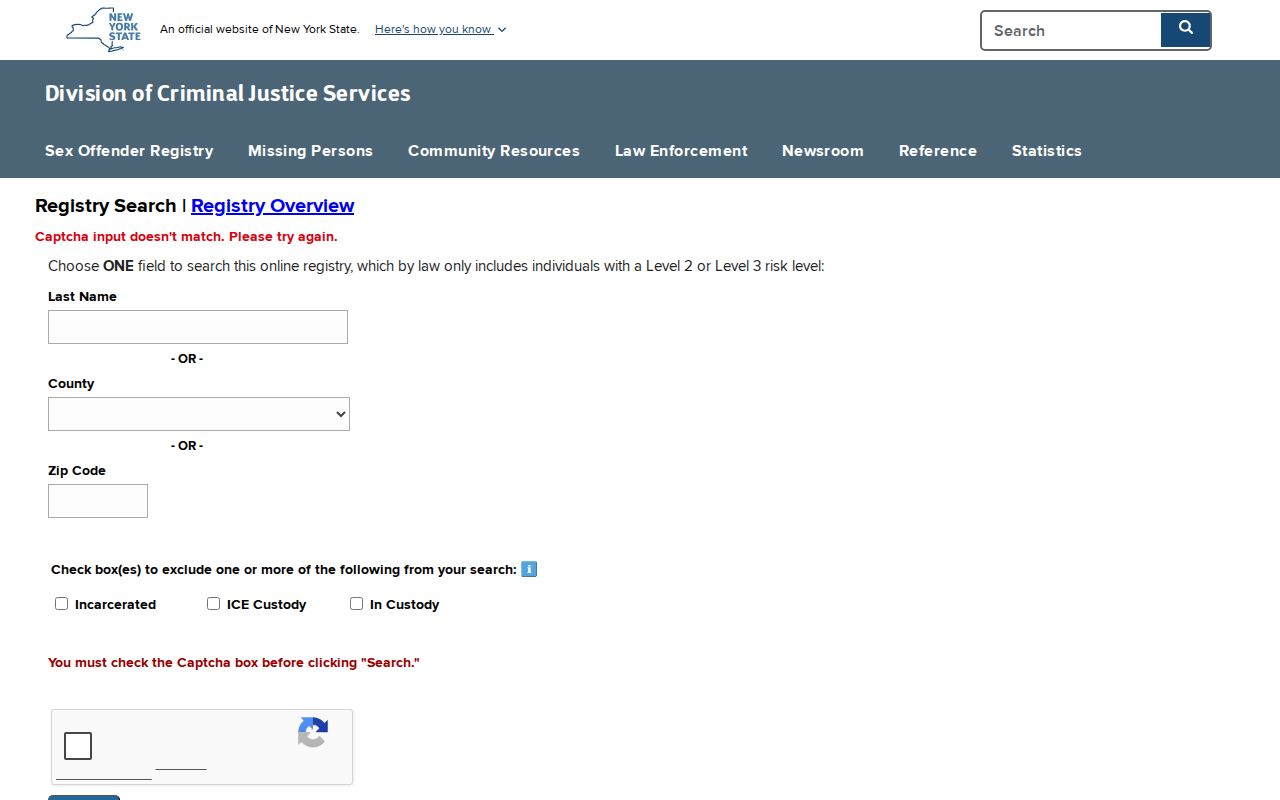
Public-system warnings and access rules stay part of the record context; a search screen is never a license to publish sensitive personal details.