
Babylon City Directory Collections
Babylon does not have a verified, continuous local Polk-style run in the research record. The dependable Babylon starting shelf is broader: Library of Congress telephone-directory holdings, dated local newspapers, Sanborn maps, and land books each preserve a different part of the historical picture. The distinction matters. A telephone listing can place a name or exchange in an edition, while a newspaper notice can supply context, and a map can show a structure without naming its occupants. Treat each as a dated source rather than a master list of Babylon residents.
| Collection | Years | Where Held | Access |
|---|---|---|---|
| LOC telephone directories | 1892; 1895-1898 holdings | Library of Congress catalog and reading room | Catalog or reading-room request; Babylon is among covered exchanges |
| South Side Signal | 1869-1920 | NYS Historic Newspapers, Babylon Library microfilm, Town Historian | Historic news and local notices; repository coverage varies |
| Babylon Leader | 1910-1958 | Babylon Library microfilm for 1921-1958; Town Historian | Civic and social notices in dated context |
| Babylon Beacon | 1967-2024 | NYS Historic Newspapers segments, library microfilm, Town Historian | Verify the issue and repository run before relying on it |
| Sanborn map series | Babylon 1885-1943 | Library of Congress and Babylon Library ProQuest access | Structure and use evidence, not a list of people |
The documented Babylon holdings have real gaps. The Library of Congress guide confirms Babylon telephone-exchange coverage in specific years, but it does not establish the first or last local printed directory, nor an exact Babylon criss-cross run. Ask for the catalog record or volume before assuming an alphabetic, address-order, or telephone section is present. The Town's local-history guide is especially useful for matching a Babylon source to its repository.
Babylon Telephone Holdings at Congress
The Library of Congress telephone-exchange guide identifies Babylon among the places covered by New York Telephone Co. and NY & NJ Telephone Co. volumes. It lists 1892 and 1895 through 1898 holdings, with multiple volumes in some years and call number HE8841.N54. That is solid evidence of available leads, not proof that every household or address appears in every volume. The actual Babylon page image, its abbreviations, and its precise entry fields still require a catalog or reading-room inspection.
The Library of Congress guide to address and telephone directories documents the Babylon telephone holdings used for this historical search route.
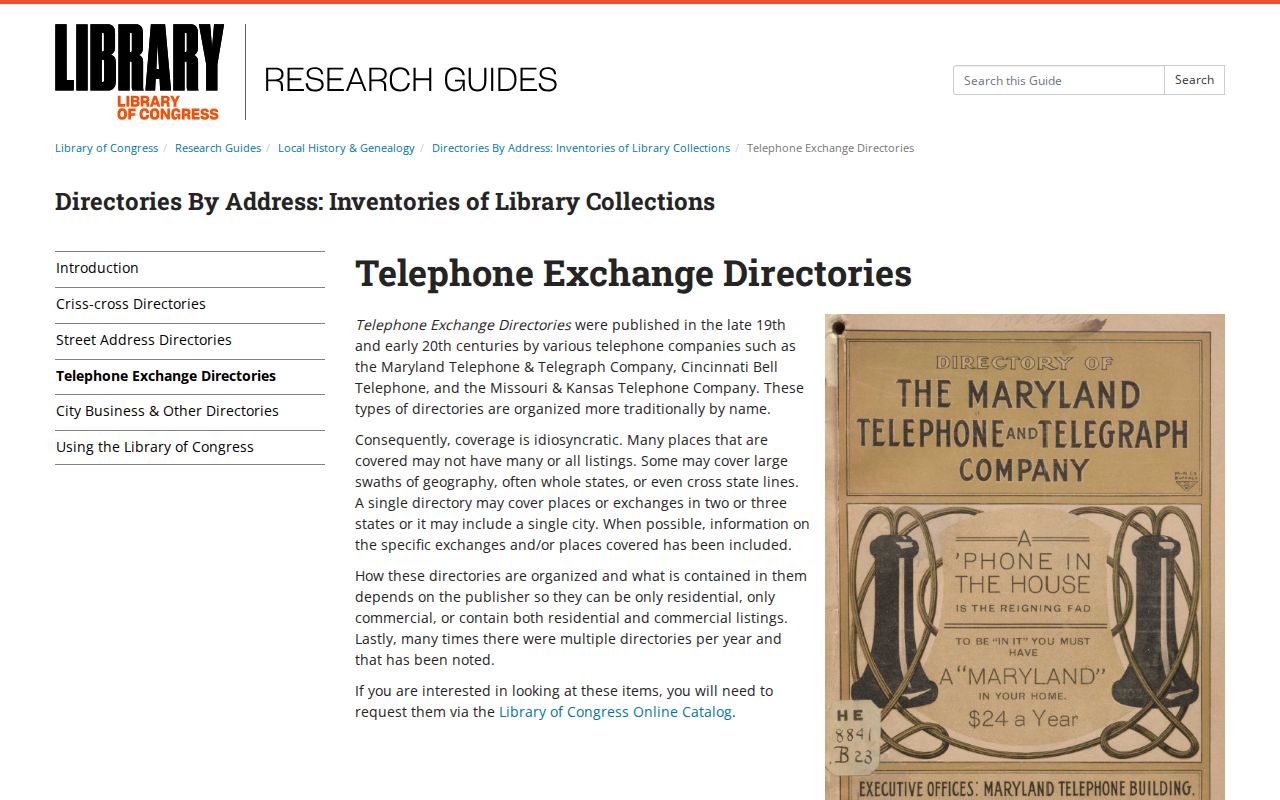
Use the guide to request or locate the relevant volume, then record the edition date and page reference beside any Babylon telephone-directory finding.
Telephone material should be read as an edition-specific Babylon trace. An appearance may supply a name, address, telephone exchange, and sometimes related personal or professional information. A nonappearance can reflect the volume, the listing policy, a spelling difference, or an unverified gap in the Babylon holdings. It does not settle ownership, a family relationship, or an uninterrupted stay at an address.
Note: Keep the volume date, call number, page, and spelling together so another researcher can recheck the same Babylon listing.
Babylon Library Directory Help
Babylon Public Library's research services are the practical local route for historical work. The library is at 24 South Carll Avenue, Babylon, and lists Ancestry, ProQuest Digital Sanborn Maps, NYS Historic Newspapers, and local-history assistance. Its published hours are Monday through Thursday 9:30-8, Friday and Saturday 9:30-5, and Sunday 1-5 from October through May. Sanborn access requires a call to the library for a library-card or barcode username and password.
For original Babylon files, photographs, and postcards, the Town guide says staff retrieval is usually required. The Town of Babylon Local History Sources Guide also directs researchers to the Town Historian and separate historical societies. The Historian's Office is at 47 West Main Street, Babylon, with 631-587-3750 and mcascone@townofbabylon.com listed in the guide. Call or email before a visit, especially when the request depends on closed-stack material.
Babylon Public Library
Research databases, newspapers, Sanborn access, and local-history assistance. 24 South Carll Avenue, 631-669-1624.
Town Historian
Local guides, history files, and referrals to the Town's historical organizations. 47 West Main Street, 631-587-3750.
Babylon Collection Dates in Numbers
The numbers make the collection boundaries visible. The documented Library of Congress Babylon telephone holdings are one 1892 point and a 1895-1898 span, not an uninterrupted directory series. South Side Signal supplies a 1869-1920 newspaper run, while Babylon Leader covers 1910-1958 and Babylon Beacon 1967-2024 in the Town guide's repository map. Babylon village Sanborn editions run from 1885 to 1943, but map coverage and person coverage are different measures.
These Babylon dates suggest where to look next, not a formula for filling a blank. A household might appear in a newspaper during a year with no located telephone volume, or a Sanborn sheet may show a Babylon structure without a name. Make a row for every source checked, its date, its keeper, and the question it actually answers. That small log prevents a long historical gap from being described as a finding.
Babylon Newspaper Directory Trail
Newspapers often bridge years that a Babylon city directory does not document. The local-history guide names the South Side Signal, Babylon Leader, Babylon Eagle, Babylon Town Leader, Babylon Town News, Babylon Beacon, Amityville Record, Lindenhurst Star, and Deer Park-Wyandanch News. Search the community name that fit the period as well as the modern label. A record from Breslau, for example, may need a Lindenhurst search, while a North Amityville or Copiague subject may be covered more usefully in the Amityville Record.
The Babylon Library research page lists NYS Historic Newspapers coverage for South Side Signal from 1869-1879 and Babylon Beacon segments from 1967-1972 and 2010-2017. The Town guide maps broader repository runs, including South Side Signal from 1869-1920 and Babylon Beacon from 1967-2024. These are not conflicting claims: one is a named online segment and the other is a repository map. Check the live archive, microfilm, or Historian collection before citing an issue.
Search Babylon surname variants, street names, churches, schools, societies, and local business terms. OCR can misread older newsprint, so a readable page image is stronger than an OCR hit. A notice may supply a date or location clue, but it should be paired with a directory, map, deed, or census source before making a Babylon household conclusion.
Reading a Babylon City Directory Entry
No actual Babylon telephone-directory entry was directly inspected in the research, so the safest method is to examine the title page and abbreviation key before transcribing a Babylon listing. Library of Congress guidance explains that directory volumes can have alphabetic, address or householder, and telephone sections, with personal or professional information and irregular publication patterns. What is on the page depends on the specific volume. Do not fill in an unobserved spouse, work description, or address detail because it seems typical of another directory.
| Name line | Use the spelling as printed, including initials, then check nearby editions for variants. |
|---|---|
| Address or exchange | A street, telephone, or exchange reference can be a dated lead, not a claim of present location. |
| Personal note | Some directory volumes include professional or spouse information; verify that the particular Babylon volume actually does. |
| Section type | Alphabetic and address-order sections answer different questions and may not both exist in a volume. |
| Edition evidence | Preserve the title, year, page, repository, and any uncertainty in a research log. |
For a Babylon item with an address-order section, check the alphabetic entry and the address entry separately, then preserve both page references. The two lines can answer different questions. A printed address can help locate a map sheet, while an alphabetic line may carry the fuller spelling. If the volume contains no matching section, report that limitation rather than borrowing an entry pattern from another city.
- Criss-cross directory
- An address-order directory used to locate a dated listing by street. No exact Babylon run has been verified, so request the volume before relying on one.
- Householder index
- An index arranged around household or address information rather than only a surname. Its presence and format depend on the edition.
- Abbreviation key
- The printed legend that explains a volume's short forms. Photograph or transcribe it before interpreting an unfamiliar mark.
Tracing Babylon Households
A Babylon family-history trail works best when each item is dated and the sources are allowed to disagree. Begin with the earliest reliable Babylon directory or telephone lead, then look forward and back one edition at a time. Pair the editions with federal census years 1900, 1910, 1920, 1930, 1940, 1950, and 1960, following the stated 72-year public-release rule. Use newspapers to test moves and spelling changes, and use deeds or maps to distinguish an address from a similarly named place.
- Record the name exactly as it appears in a dated Babylon telephone or directory volume.
- Compare the prior and next available editions, keeping a separate note for each spelling or address variation.
- Check the corresponding census year and note whether the address, community label, and household pattern agree.
- Search a local newspaper title that served the community in that period for notices or place-name clues.
- Use a deed, tax map, or Sanborn page only for the separate question it can answer, then mark unresolved gaps.
A name disappearing from an edition has several possible explanations: a move, a death, a listing change, an unindexed variant, or a missing volume. It is not a conclusion by itself. When the work shifts from a dated household clue to an address-by-address historical trail, the Babylon previous residents resource keeps the deed, map, and census work in that separate context.
Babylon Maps Beside Directories
Maps make a Babylon directory finding more useful without turning it into a title record. The Town guide lists Beers, Comstock & Cline's 1873 atlas, E. B. Hyde volumes from 1902, 1909, 1915, and 1917, plus a c.1929 Dolph & Stewart atlas. The guide cautions that the 1929 atlas has little owner or structure detail and is not reliable for every parcel. That caveat belongs in any comparison.
Sanborn coverage is more precise for many built places. Babylon village has documented editions from 1885, 1890, 1897, 1902, 1908, 1915, 1923, 1929, and 1943. A sheet can show whether a mapped structure existed in a stated month or year, along with footprint, construction material, height, and fire-protection detail. It generally does not identify the owner or occupant. Read the map key and index, and keep historic Babylon village coverage distinct from the larger Town of Babylon geography.
Note: A map, directory, and newspaper can corroborate a time slice, but none alone proves a continuous household history.
Babylon's 1872 Records Story
Babylon's record trail has a local beginning. The Town of Babylon was created in 1872, and early government business took place in hotels and private homes while Clerk records were kept in a rented office. The Town describes Babylon Clerk records and minutes as running from 1872 to the present. Old Town Hall, later rededicated as a History Museum in 2010, is a useful Babylon civic-history anchor for research that cannot be answered by a telephone volume alone.
The story also warns against a convenient but unsupported claim. The reviewed Town guide does not identify a courthouse fire or a complete local records loss, and it does not verify a first or final Babylon Polk directory year. State those gaps plainly. Directory evidence is stronger when it names the edition and keeper; it is weaker when it turns a missing catalog hit into a story about a lost record.
Limits of Babylon City Directories
Historical Babylon city directories are useful for family history, local research, and understanding a neighborhood at a particular date. They are not a safe way to construct a present-day contact list. A listing can be incomplete, a person can share a name with someone else, and a Babylon address can be a place of work, a postal reference, or a historical business location. Combine at least two non-sensitive anchors, such as the dated edition and a map or deed, before treating a match as likely.
A Babylon directory volume also cannot settle a legal boundary, ownership, or the status of a later record. Babylon, Lindenhurst, Amityville, and hamlet labels can shift by source and period. Preserve the name printed in the original source, keep the date visible, and use the office that maintains the relevant record when a historical lead needs formal confirmation.